Statistics of appeals to the Commissioner for Human Rights of the Republic of Kazakhstan in 2021
The Ombudsman continues to receive complaints about human rights violations in closed institutions
According to the National Center for Human Rights, as of November 2021, a total of 1,614 appeals were received by the Commissioner for Human Rights in the Republic of Kazakhstan, Elvira Azimova.
Most often, the relevant complaints of citizens concerned the actions or inaction of officials of the prosecutor's office and the police (298 appeals), as well as appeals against judicial acts (215 appeals). Among other common types of appeals, the following categories can be noted: "general issues of the penal enforcement system", "general issues of criminal procedure legislation", "provision of housing", "health issues, public health protection", "constitutional rights and freedoms of a citizen", "labor relations", etc.
163 appeals related to human rights violations in correctional institutions of Kazakhstan, including complaints about medical care, abuse of official position, violation of communal living conditions, and the use of torture.
It should be noted that the problem of torture, ill-treatment and other violations of citizens' rights in closed institutions traditionally remains one of the key issues in the field of view of both human rights defenders and law enforcement agencies.
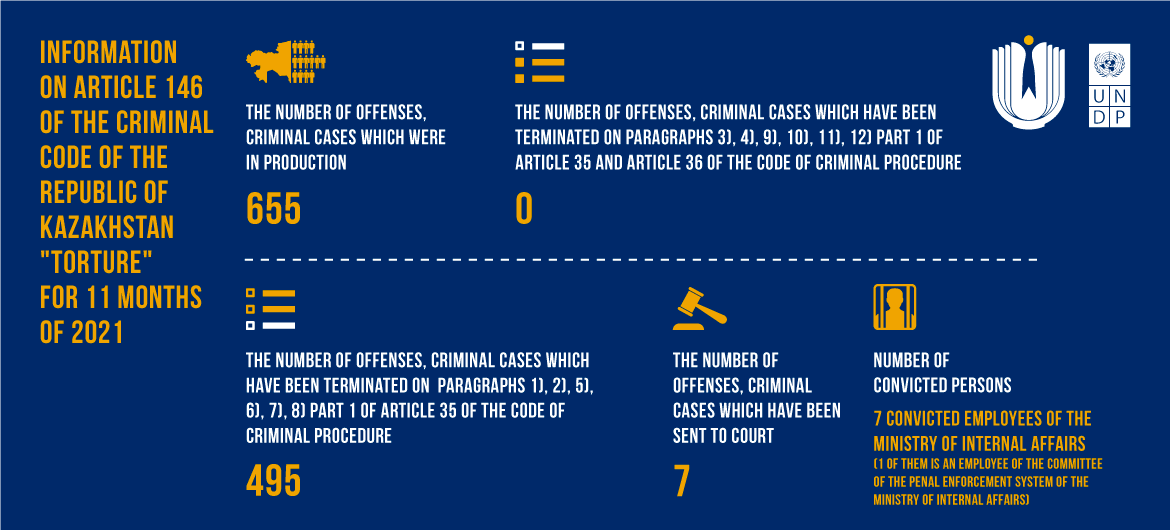
According to the updated data, for 11 months of this year under Article 146 of the Criminal Code of the Republic of Kazakhstan ("Torture"), 655 criminal cases were in production.
The number of offenses, criminal cases of which have been terminated on points 1), 2), 5), 6), 7), 8) Part 1 of Article 35 of the Criminal Procedure Code of the Republic of Kazakhstan, amounted to 495 of the above 655.
In general, this year 7 employees of the Ministry of Internal Affairs of the Republic of Kazakhstan were convicted under the article "Torture" (1 of them is an employee of the Ministry of Internal Affairs of the Republic of Kazakhstan).
According to his mandate, the Commissioner for Human Rights in the Republic of Kazakhstan coordinates the activities of the National Preventive Mechanism against Torture and Ill-Treatment (NPM), aimed at identifying cases of human rights violations in penitentiary institutions and other special institutions that provide temporary isolation from society. The activities of the NPM are carried out with the support of the Government of the Republic of Kazakhstan, the UN Development Program, and other international organizations.
In Kazakhstan, the Institute of NPM exists and has been developing for 7 years. The NPM participants, in addition to the Commissioner for Human Rights, include members of public monitoring commissions and public associations selected among Kazakhstani citizens who carry out activities to protect the rights and legitimate interests of citizens, lawyers, social workers, doctors.
The task of the experts involved in the work of the NPM is regular, sudden for the administrations of institutions and confidential visits to places of isolation of people from society to monitor the observance of the rights and freedoms of those who are in them.
NPM participants annually conduct monitoring visits to about 500 institutions. In general, the number of institutions covered by the NPM currently stands at more than 3,000 across the country. Such institutions, in addition to prisons, also include pre-trial detention centers, police stations, drug treatment dispensaries, healthcare organizations for orphans, centers for the provision of special social services for the elderly and disabled groups 1, 2, etc.
As a result of the relevant monitoring, many of the appeals received by the Commissioner were identified and accepted. Based on the results of all appeals and complaints identified during monitoring visits, inspections are carried out, letters are being prepared or have already been sent to the authorized bodies.
It is worth noting that complaints and appeals of persons held in closed institutions signal existing violations of the UN Convention against Torture and Other Cruel, Inhuman or Degrading Treatment or Punishment, to which our country is a State party.
According to the Consolidated Report of the NPM participants for 2019-2020, 1012 monitoring visits were conducted, including 479 periodic, 459 intermediate, and 74 special.
In the context of the coronavirus pandemic, many States have imposed restrictions on visiting people in closed institutions, which has created additional risks of ill-treatment. It should be noted that in Kazakhstan, during a state of emergency, the NPM participants did not suspend their work. During the quarantine period alone, 159 preventive visits were carried out, 43 video calls (online interviews) of NPM participants with persons in closed institutions, 58 telephone consultations were given. Thus, the number of preventive visits throughout the country increased to 517 last year, which exceeds the figures of 2019 by 22 visits.
According to the updated data, as of November 2021, NPM participants have already conducted 507 visits to closed institutions.
The total number of recommendations given by NPM participants based on the results of preventive visits in 2021 amounted to 3,667. In the context of state bodies, recommendations were sent to the CUIS, the Ministry of Internal Affairs, the Ministry of Health, the Ministry of Health, the Ministry of Defense, and the National Security Committee of the Republic of Kazakhstan.
The recommendations concern both the conditions of detention (residence) of persons, as well as their medical care, nutrition, education, provision of necessary clothing, and leisure.
However, not all recommendations receive the support of authorized state bodies. So, for example, out of 1201 recommendations of the Ministry of Internal Affairs of the Republic of Kazakhstan, 240 recommendations have been implemented, 926 recommendations are at the stage of implementation, and 35 recommendations have not been accepted by this department. The Ministry of Health of the Republic of Kazakhstan has implemented 122 recommendations of NPM participants out of 623, 492 recommendations are at the stage of implementation, and 9 have not been accepted.
We should add that on December 10, the world community celebrates Human Rights Day — it was on this date in 1948 that the UN General Assembly adopted the Universal Declaration of Human Rights.