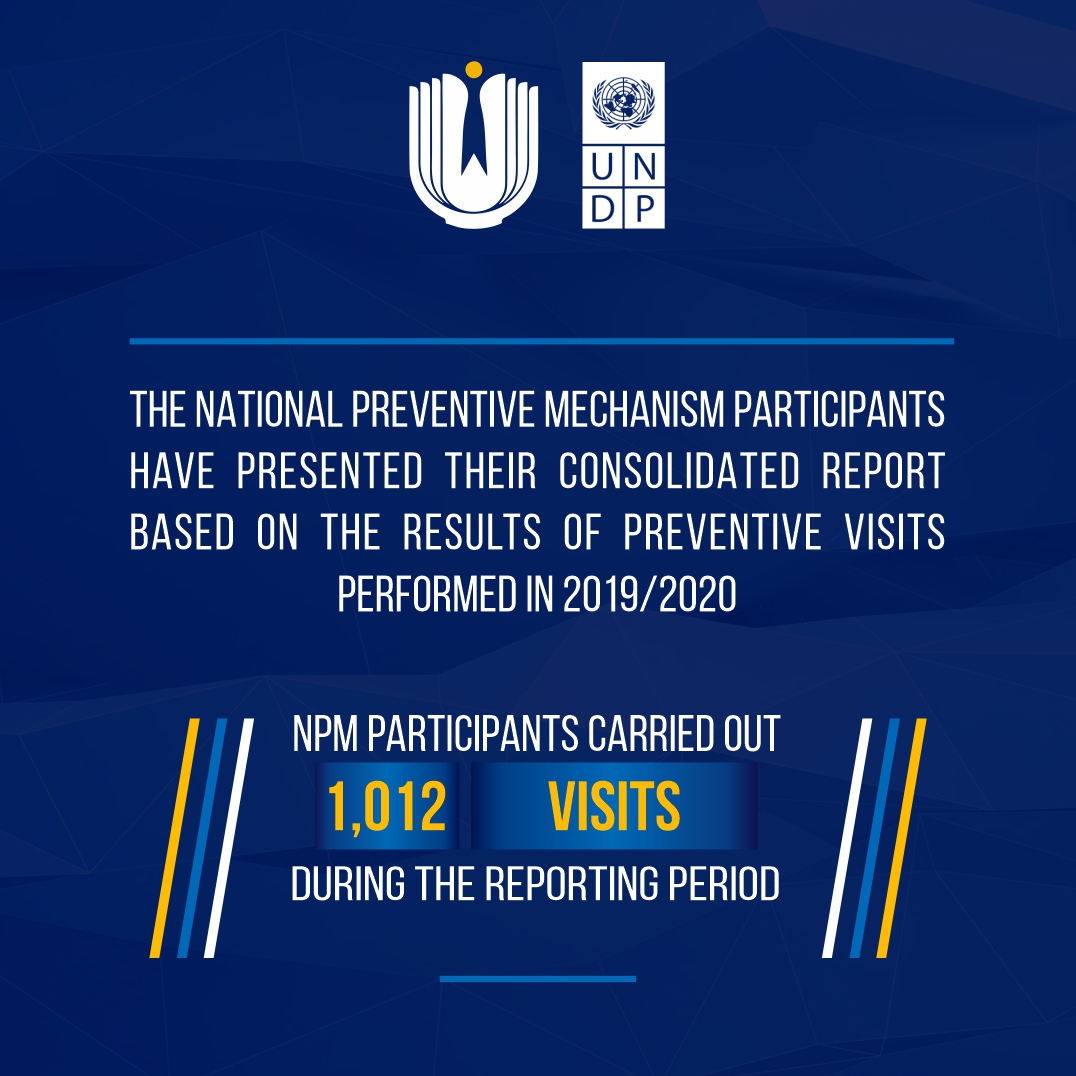
THE CONSOLIDATED REPORT OF THE PARTICIPANTS OF THE NATIONAL PREVENTIVE MECHANISM FOR 2019-2020 IS PRESENTED
On September 2, 2021, the presentation of the Consolidated Report of the participants of the National Preventive Mechanism (NPM) for 2019-2020 was held. Additionally: The event was attended by representatives of the UN Development Program in Kazakhstan, the UN Office on Drugs and Crime, Penal Reform International (International Prison Reform) in Central Asia, several non-governmental organizations, as well as employees of state bodies represented by the Ministry of Internal Affairs of the Republic of Kazakhstan, the National Security Committee, the Ministry of Defense of the Republic of Kazakhstan, the Ministry of Health of the Republic of Kazakhstan.
The NPM acts as a kind of public control of closed State institutions to detect and prevent torture and other cruel, inhuman, or degrading treatment or punishment.
The NPM's mandate to monitor the prevention of torture and other inhuman and degrading forms of ill-treatment covers more than 3,000 institutions throughout the country, including institutions under the jurisdiction of law enforcement agencies and social services.
By the legislation of Kazakhstan, NPM participants visit these institutions in case of appeals from citizens who are in them on the facts of possible torture and other types of ill-treatment. In the future, the participants of the NPM signal the results of visits to the prosecutor's office and authorized bodies. Based on the results of monitoring visits, NPM participants annually prepare and submit a consolidated report to state bodies and other interested organizations to take appropriate measures to eliminate the identified violations and prevent the risks of their repeated commission.
The peculiarity of the event was that the NPM report for two years was presented because in 2020 the presentation of the NPM report was not possible due to objective circumstances related to a lockdown in a pandemic.
More than 100 people took part in the presentation of the report: not only the NPM participants themselves, representatives of central state bodies and international organizations, but also heads of territorial state bodies and institutions visited by NPM participants.
The participants of the NPM presented a full analysis of the identified violations in the field of human rights, identified the risks that state bodies should adopt, and also presented their recommendations for the prevention of violations.
According to the participants of the NPM, 1012 preventive visits were conducted in 2019-2020. At the same time, 74 visits were associated with specific appeals of citizens.
According to the National Center for Human Rights, in 2020, 393 complaints from convicts were received by the NPM. By their nature, different questions were raised: about extradition, about wages and social security, about the restoration of documents, about the provision of legal assistance, about explaining the legislation, about improper nutrition and medical care, about parole or the replacement of a more lenient sentence, about appealing judicial acts, about the illegal pre-trial investigation, as well as about torture and other types of ill-treatment.
For example, during 2019, the NPM participants visited 6 women's colonies in the Republic of Kazakhstan, so a special place was paid to the observance of human rights about convicted women in the presentation. By the way, in Kazakhstan in 2019, 1,531 women served their sentences in places of deprivation of liberty. Compared to 2020, there were 1,606 convicted women in the colony. Practice shows that convicted persons and citizens staying in social institutions and who are recipients of special social services belong to the most vulnerable category of citizens in terms of respect for human rights and standards of their detention (stay).
"The system of execution of punishment today is a constant target for criticism in the world community. The main reason for criticism is the non-compliance with the standards of detention of persons serving sentences, which leads to a violation of their rights. There is also a second reason - this is the openness of the institutions of the supervisory commissions and groups of the National Preventive Mechanism for many years, " said Yuri Gusakov, head of the NPM group for the Karaganda region.
Asiya Nurpeisova, a member of the Coordinating Council of the NPM, head of the group of NPM participants in the Aktobe region, stressed that, as in previous years, the main number of appeals from citizens who were in pre-trial detention centers is associated with poor conditions of detention. The situation has not changed much at present - places of detention are often old buildings with unsanitary conditions, problems of access to drinking water and heat supply.
According to the National Center for Human Rights, NPM participants made 3,319 recommendations based on the results of preventive visits in 2020. The largest number of recommendations were sent to institutions subordinate to the Ministry of Internal Affairs of the Republic of Kazakhstan (temporary detention centers( IVS), special receivers for the detention of persons arrested administratively (SPAA), PR, police department (OP), UP, DP) and amounted to 1107 recommendations. In addition, 750 recommendations were sent to correctional institutions, pre-trial detention centers subordinate to the CUIS of the Ministry of Internal Affairs of the Republic of Kazakhstan.
A member of the Coordinating Council of the NPM, the head of the NPM group for the Mangystau region, Alexander Mukha, noted positive improvements in children's social institutions. At the same time, some systemic problems remain, the solution of which is possible with the principled support of the akimats and the Ministry of Education and Science of the Republic of Kazakhstan.
"It should be noted that the situation can be changed only if all departments at the leadership level, with the support of local executive bodies, show the political will to fulfill their obligations to respect the rights of children, especially those who find themselves in a difficult life situation. It is important to promote regular independent monitoring and systematic analysis in children's closed institutions, which would help to determine the real picture of the conditions of detention and would serve as a justification for the formation of a policy in the best interests of the child and an appropriate budget for the needs of the child," said Roza Akylbekova, a member of the Coordinating Council of the NPM.
The Permanent Representative of the UNDP in the Republic of Kazakhstan, Yakup Berish, noted in his speech: "The NPM has proved its value and importance in solving the tasks of preventing torture and ill-treatment in closed institutions, which is especially relevant given the global COVID-2019 pandemic. We saw that the NPM in Kazakhstan followed all the recommendations of the UN Committee for the Prevention of Torture and successfully continued preventive visits during the quarantine regime."
"Despite the expansion of the list of institutions falling under the mandate of the NPM, taking into account the accumulated experience, it may be time to create a separate law for the NPM. It is important that state bodies respond to the recommendations of the NPM, " suggested Omer Fischer, Deputy Representative of the Office of the United Nations High Commissioner for Human Rights for Central Asia.
The Commissioner for Human Rights Elvira Azimova recalled that the Kazakh NPM works according to the "Ombudsman +" model and stressed the following: "Kazakhstan has declared a zero-tolerance policy for torture and other forms of ill-treatment at the international level. We will continue our mission in cooperation with civil society and maintain feedback with state bodies to ensure a prompt response from the authorized bodies."
According to the Ombudsman, the recommendations of the NPM participants based on the results of 2019-2020 are taken into account when developing draft laws on the transfer of the medical service from the jurisdiction of the penitentiary system of the Ministry of Internal Affairs to the jurisdiction of the Ministry of Health of the Republic of Kazakhstan, as well as in the framework of improving criminal legislation. These draft laws are under discussion as part of the Government's Plan for Priority Measures in the Field of Human Rights.
Consolidated Report of the NPM can be found on the official website of the Commissioner for Human Rights in the Republic of Kazakhstan at the following link: https://www.gov.kz/memleket/entities/ombudsman/documents/details/210090?lang=ru