Gold of Great Steppe Exhibition Opens at Cambridge University’s Fitzwilliam Museum
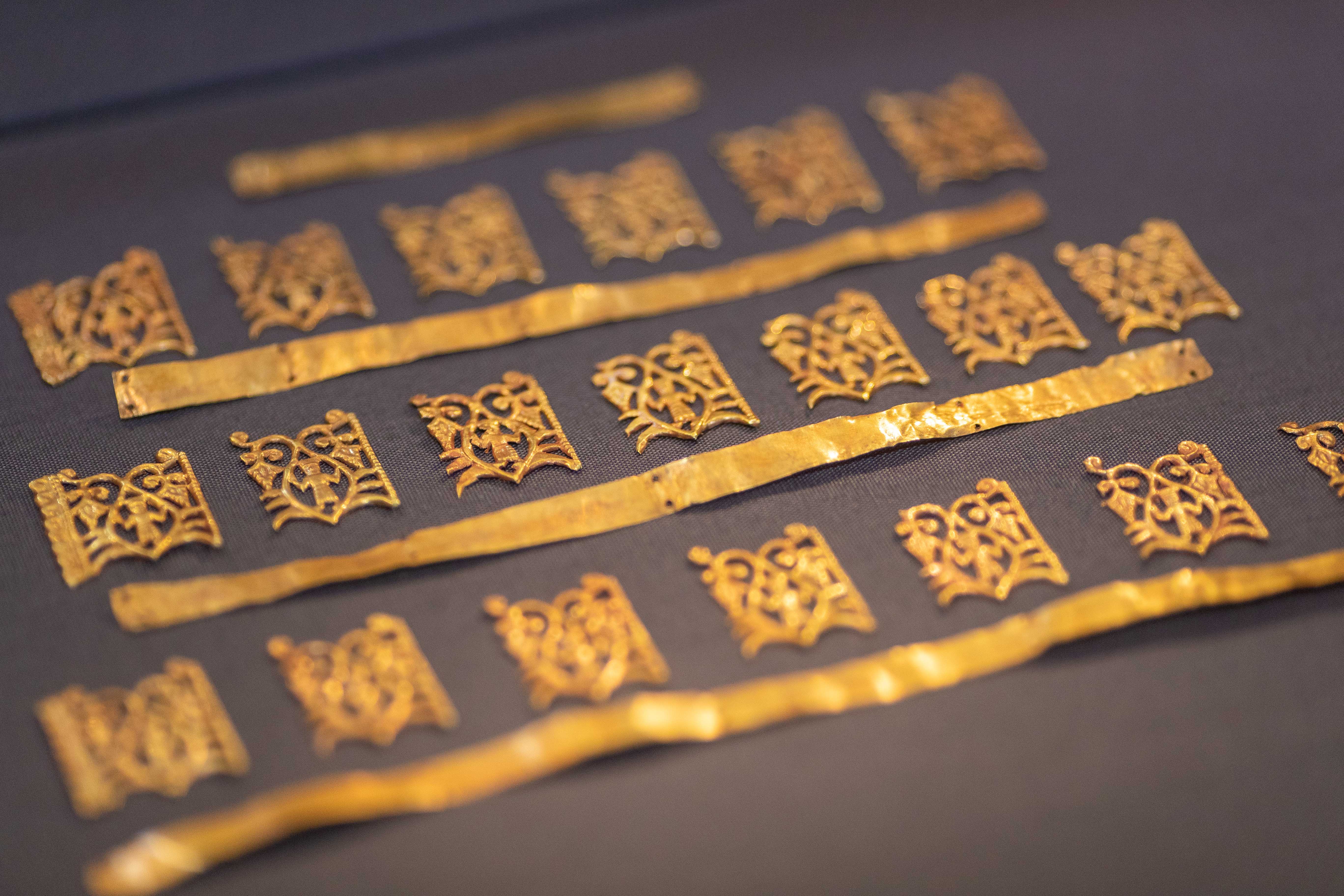
Cambridge, September 27, 2021 – Gold of the Great Steppe exhibition, branded by the UK media as an “international archaeological sensation,” opened at the Fitzwilliam Museum, the University of Cambridge’s principal museum.
Hundreds of unique gold artefacts dating back more than 2,700 years and discovered over the past three years in ancient burial mounds built by the Saka people in the East Kazakhstan Region are on display for the international audience for the first time in the year of the 30th anniversary of Kazakhstan’s Independence.
The Saka culture of Central Asia, which flourished between the 8th and the 3rd centuries BCE, was one of the early manifestations of the Scythian civilisation that dominated the steppes from the Black Sea to Siberia. Located in the Altai mountain system on the territory of modern Kazakhstan, the Saka of East Kazakhstan were a sophisticated civilisation of the ancient world.
The exhibition presents archaeological finds and research from three different burial complexes: Berel, Shilikti and Eleke Sazy. It will allow visitors to discover the life, history and legacy of the Saka people and explore points of resonance with Kazakh culture today.
In his article “Independence above all,” President Kassym-Jomart Tokayev stressed the need for deep research of Kazakhstan’s history with the help of new scientific approaches, which will contribute to the revival of the nation’s historical identity. The results of archaeological excavations and research by Kazakh scientists present new information about the Saka as a complex civilisation with advanced technological skills. Latest non-invasive technology will allow the scientists at the McDonald Institute for Archaeological Research, University of Cambridge, to uncover new secrets held by the unique artefacts from Kazakhstan.
Speaking at the opening event, Luke Syson, Director of the Fitzwilliam Museum, said: “The exhibition not only celebrates a remarkable history and culture, but it demonstrates the value of collaborative, cutting-edge research and the exhibitions that arise from it, providing a much more complete understanding of global history than we have had before… This exhibition is all about promoting greater understanding, challenging Eurocentric ideas about this region that go back to Herodotus and promoting a better appreciation, through the artefacts that we see, of how the great people lived within a beautiful landscape.”
On show in the exhibition are the spectacular contents from an extremely rare undisturbed intact Saka burial, only the second to be discovered on the territory of Kazakhstan. In a richly furnished grave, a teenage archer, no older than 18 when he died, was buried in the same chamber with a younger female close relative, aged 13-14. While the girl’s remains were heavily looted in antiquity, the grave of the male youth appears to have been protected from being plundered by a rock fall, which shielded him from view and knowledge of his existence for over 2,500 years. The golden artefacts that were laid alongside him were exceptionally preserved and are now on display at the exhibition as a reconstruction of the burial.
Danial Akhmetov, Akim (Governor) of the East Kazakhstan Region, noted that a large-scale unique archaeological research programme was launched in the region five years ago. Dozens of new archaeological sites were discovered and studied within that programme.
“The exhibition presents authentic masterpieces created by our ancestors, and these items demonstrate that the ancient Saka had a unique culture and deep knowledge of nomadic cattle breeding, mining and metallurgy. The artefacts presented to your attention were discovered by Kazakh archaeologists in East Kazakhstan, in the kurgans of the Saka elite of the 7th and the 6th centuries BC. This period is also called the Golden Age in the history of ancient Kazakhs. One of the most outstanding exhibits is the remains of the “Golden Man,” whose attire counts 15,000 gold items,” he added.
The artefacts show the use of highly skilled metalworking techniques, indicating an exceptional level of artisanship of the Saka people. The artistic language of the Scythian animalistic style indicates a deep respect and understanding of the animals of the Great Steppe, both real and mythical.
In particular, the relationship between horses and humans has its earliest origins on the territory of Kazakhstan. The Saka were expert equestrians, often taking their beloved horses with them to the grave and the afterlife beyond. In the burials, the horses were specially decorated with gold pieces, which transformed them into mythical beasts and revealed their true spirit.
The partnership between the East Kazakhstan Regional Museum of Local History and the University of Cambridge will bring the archaeological research of Kazakh scientists to a new level. The results of joint research will be included in the exhibition, including digitally, and lay the foundations for further work.
Within the exhibition, the University of Cambridge will also conduct a series of lectures, including a guest lecture by two leading Kazakh archaeologists, Professor Zainolla Samashev and Professor Abdesh Toleubayev, who led the excavations of the Saka mounds and whose research underpins the exhibition.
“In the coming few months, we will celebrate a number of important milestones, including the 30th anniversary of Kazakhstan’s independence and the 30th anniversary of the establishment of a diplomatic relationship between Kazakhstan and the United Kingdom. I find it very timely and symbolic that the Gold of the Great Steppe exhibition has opened in one of the best UK museums at such an auspicious time,” said Erlan Idrissov, Ambassador of Kazakhstan to the UK.
Gold of the Great Steppe runs from 28th September 2021 to 30th January 2022 in the Mellon and Adeane Galleries at the Fitzwilliam Museum.