Nauryznama Framework and Kazakhstan’s Intangible Cultural Heritage Presented at UNESCO Headquarters
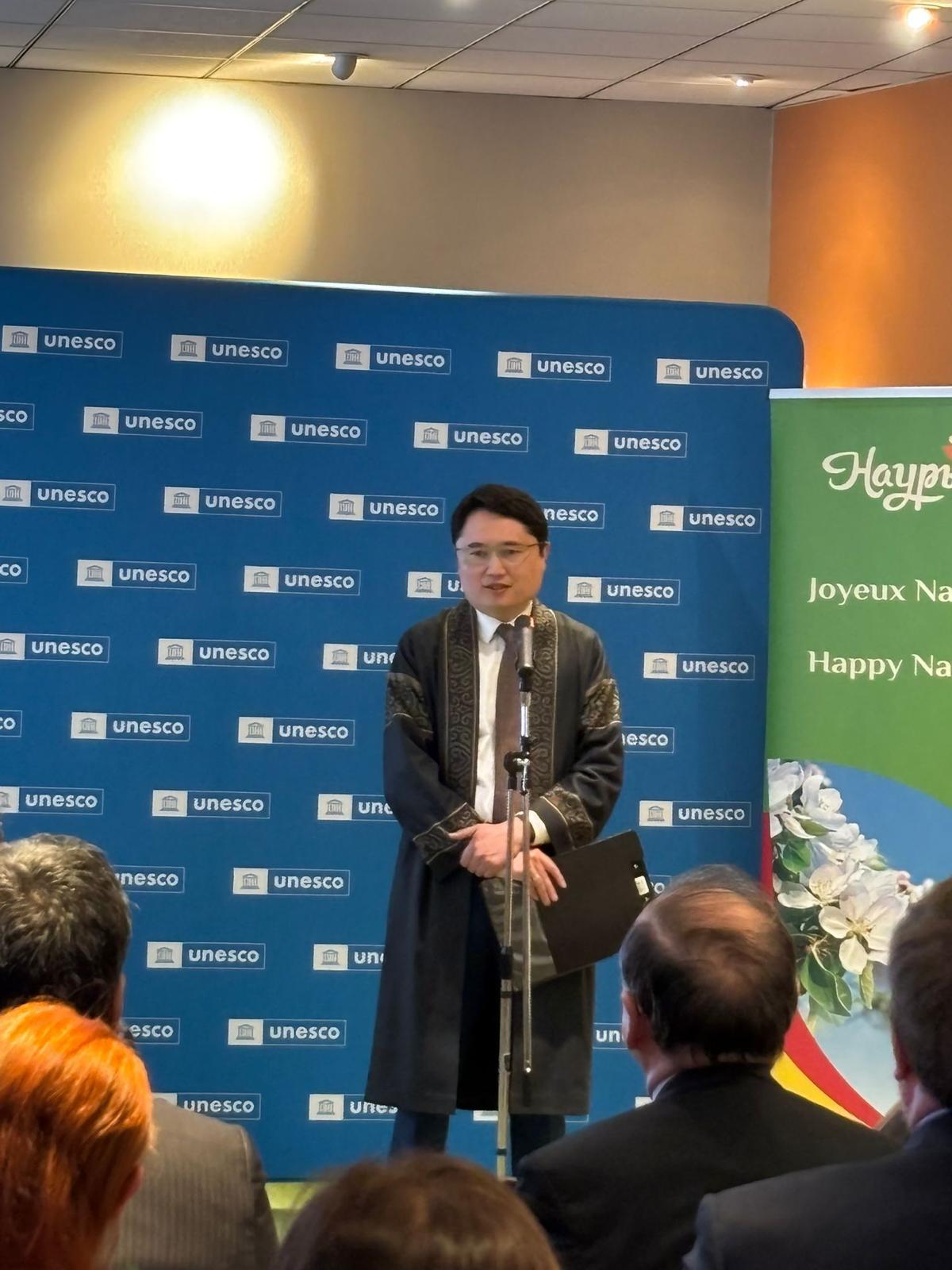
As part of the ten-day long Nauryznama program of thematic events, the Permanent Delegation of Kazakhstan to UNESCO organized a presentation of the country’s intangible cultural heritage at the Organization’s headquarters.
The event, held on 18 March 2026 with the support of the Abai Cultural Centre under the Embassy of Kazakhstan in France, brought together heads of diplomatic missions of UNESCO Member States, Secretariat staff, friends of Kazakhstan, and representatives of the Kazakh diaspora.
Opening the event, the Permanent Delegate of the Republic of Kazakhstan to UNESCO, Ambassador Askar Abdrakhmanov, reminded the audience that Nauryz is one of the oldest holidays in the world, symbolizing the renewal of nature, harmony, and unity among peoples. He noted that this year the spirit of spring renewal in Kazakhstan is also associated with comprehensive reforms in the country and the adoption of a new Constitution through a nationwide referendum held on 15 March.
The Ambassador introduced the audience to the main content of the Nauryznama decade, emphasizing that it reflects the core values and traditions of the Kazakh people, including tolerance, friendship, care for others, and respect for nature. Guests were presented with a thematic brochure and video materials.
A. Abdrakhmanov underlined importance of international cooperation in safeguarding the intangible cultural heritage. In this context, it was noted that the tradition of celebrating Nauryz was jointly nominated by 13 countries and inscribed by UNESCO on the Representative List of the Intangible Cultural Heritage of Humanity, reflecting the shared cultural traditions in this vast region.
For her part, the Secretary of the 2003 Convention for the Safeguarding of the Intangible Cultural Heritage, Fumiko Ohinata, highlighted Kazakhstan’s vibrant contribution to the cultural diversity of the humankind and its active engagement within UNESCO’s mechanisms. Congratulating the audience on the upcoming Nauryz, she emphasized that the sounds of the dombra, the skills of yurt making, traditional games, and other elements of spiritual heritage are among the vivid symbols of Kazakhstan in today’s world. She also reaffirmed UNESCO’s commitment to continued cooperation with Kazakhstan in promoting their international recognition and safeguarding.
As a sign of friendship and appreciation for many years of cooperation with UNESCO, and on the occasion of the National Clothing Day, the Permanent Delegate of Kazakhstan, to the applause of the audience, presented the Secretary of the Convention for the Safeguarding of the Intangible Cultural Heritage with a traditional Kazakh robe known as shapan.
The evening’s programme showcased the richness and diversity of Kazakhstan’s cultural heritage. In particular, France-based Kazakh artist Zhanel Zhubanova demonstrated the ancient art of felt-making, presenting both the process of crafting felt items and her own works in this technique that reflects the deep connection between the people and their natural environment.
In this context, it was noted that the multinational nomination of Traditional Felt Making jointly submitted by Azerbaijan, Iran, Kazakhstan, Kyrgyzstan, Mongolia, Tajikistan, Türkiye, and Uzbekistan, will be considered for inscription on UNESCO’s Representative List of the Intangible Cultural Heritage of Humanity in December 2026.
The musical part of the evening featured the performance with dombra of Kurmangazy’s kuy Adai by Niyaz Torebek, as well as of the song Qarlygash delivered by Gauhar Rustemkyzy. Chingis Kuanbayev introduced the guests to the ancient intellectual game Togyzkumalak, previously inscribed on UNESCO’s lists as a shared heritage of Kazakhstan, Kyrgyzstan, and Türkiye.
On National Clothing Day, particular attention was drawn to the presentation of traditional men’s and women’s costumes, highlighting the richness of ornaments, materials, and symbolic meanings embedded in them.
The evening concluded with a tasting of meals representing Kazakh culinary culture, including qazaqsha et (beshbarmak), nauryz kozhe, as well as traditional sweets and dairy products.
The presentation of the Nauryznama program of festivities at UNESCO Headquarters once again demonstrated Kazakhstan’s solid commitment to safeguarding and promoting intangible cultural heritage, as well as to strengthening intercultural dialogue domestically and globally.