Issues of the Aral Sea and the Consequences of Nuclear Testing at the Semipalatinsk Test Site Presented at the Council of Europe
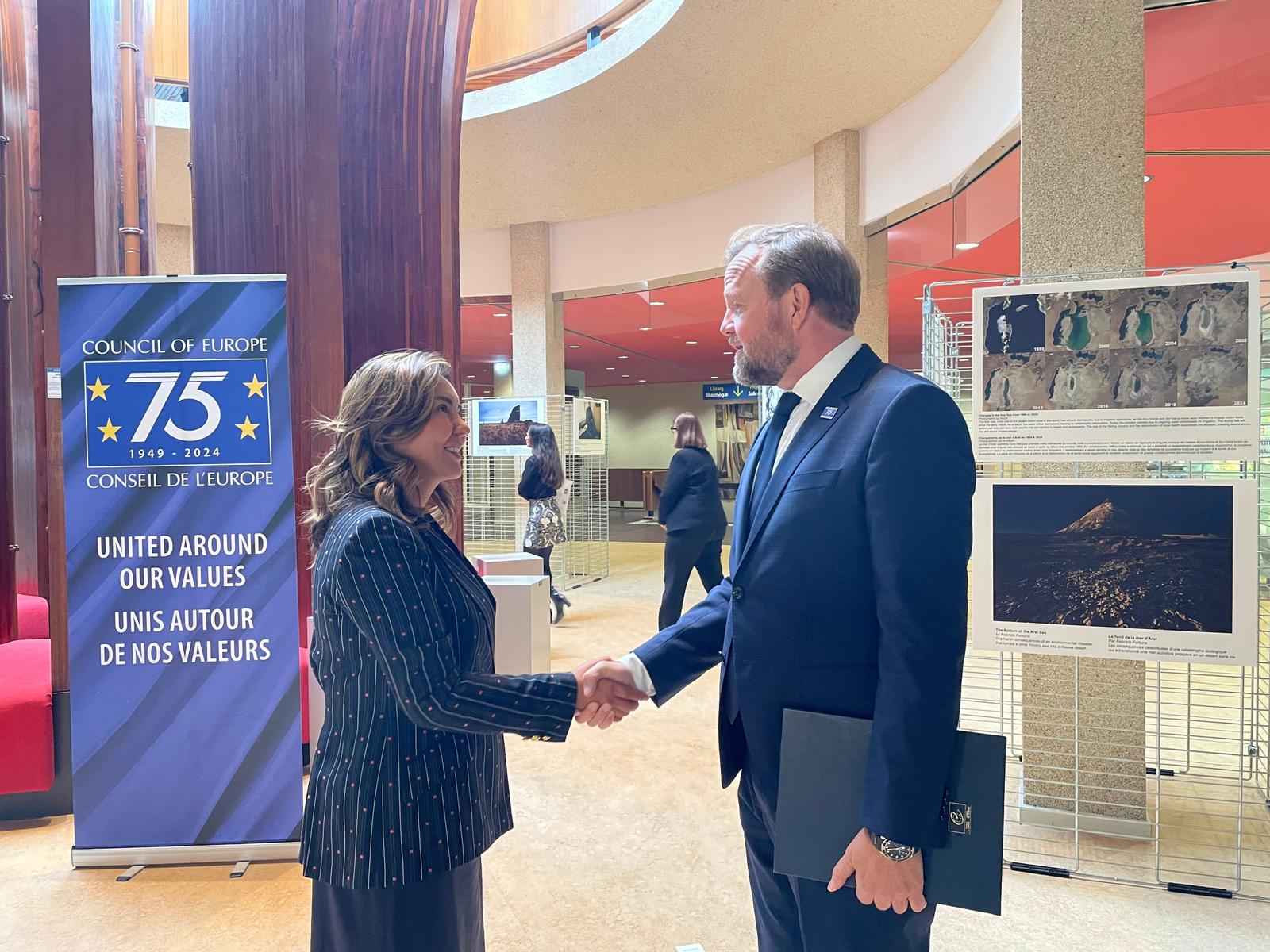
Strasbourg, September 16, 2024 – The Consulate General of the Republic of Kazakhstan in Strasbourg organized a photo exhibition at the headquarters of the Council of Europe dedicated to disarmament and citizens’ environmental rights, titled “Harmony of the World: Disarmament and Environmental Security.”
At the opening ceremony, speeches were given by the Consul General of Kazakhstan, Anel Bakytbekkyzy, Deputy Secretary General of the Council of Europe, Bjørn Berge, Japan’s Consul General, Hiroyuki Uchida, and the Vice President of the International Anti-Nuclear Movement “Nevada-Semipalatinsk,” Sultan Kartoev.
In her opening remarks, Bakytbekkyzy spoke in detail about the Aral Sea crisis, particularly emphasizing the health consequences of the environmental disaster affecting millions of people. She raised concerns of scientists over the shortage of fresh water, droughts, floods, reduced agricultural yields, the threat of future climate-induced migration, and the harmful impact on the ecosystem extending beyond Central Asia.
“Kazakhstan, as the country most affected by the consequences of nuclear tests and the drying of the Aral Sea, continues to draw the attention of the international community to these issues that concern all of humanity. In this context, the priorities of Kazakhstan’s current chairmanship in the International Fund for Saving the Aral Sea were outlined, as well as the country’s intentions to implement innovative solutions in the water sector and improve the environmental situation, as expressed by President Kassym-Jomart Tokayev in his recent annual State of the Nation Address “Fair Kazakhstan: Law and Order, Economic Growth, and Social Optimism,” noted Bakytbekkyzy.
It was noted that Kazakhstan continues to steadily enhance its cooperation with all UN member states on issues of nuclear disarmament and non-proliferation, as well as the peaceful use of atomic energy. In this regard, the Government of Kazakhstan has set the goal of achieving carbon neutrality by 2060 as part of the country’s first-ever Low-Carbon Development Strategy, adopted in 2023. In this context, exhibition participants were informed of Kazakhstan’s proposals to establish a Central Asian project office in Almaty focused on climate and green energy, as well as to hold a Regional Climate Summit in Kazakhstan in 2026.
Deputy Secretary General of the Council of Europe, Bjørn Berge, speaking at the exhibition, praised Kazakhstan’s role in global efforts for nuclear disarmament and addressing environmental issues.
“Kazakhstan made a historic decision to renounce its nuclear arsenal after the end of the Cold War, symbolizing its commitment to peace and disarmament,” politician emphasized.
Bjørn Berge also gave special attention to the Aral Sea environmental disaster in his speech.
“The photo exhibition broadly highlights the tragedy of one of the world’s largest inland bodies of water, which has almost disappeared over the decades, leaving behind severe environmental, economic, and social consequences. In this regard, Kazakhstan’s and other countries’ efforts will help find new ways to achieve nuclear disarmament and restore environmental balance on the planet,” concluded Berge.
Japan’s Consul General Uchida, in his speech, praised the close cooperation between Japan and Kazakhstan in the field of nuclear disarmament.
“Kazakhstan has played a significant role in global nuclear disarmament by voluntarily relinquishing the world’s fourth-largest nuclear arsenal after gaining independence. Following the atomic bombings of Hiroshima and Nagasaki in 1945, Kazakhstan also experienced the devastating consequences of nuclear tests at the Semipalatinsk test site. Japan fully supports Kazakhstan in various projects aimed at assisting the victims and eliminating radioactive contamination,” diplomat stated.
According to Uchida, thanks to Kazakhstan’s initiative and the international anti-nuclear movement “Nevada-Semipalatinsk,” a nuclear-weapon-free zone was established in Central Asia, further strengthening Kazakhstan’s position on the global stage.
During a conversation on the sidelines of the exhibition, Bakytbekkyzy also informed participants about Kazakhstan’s ongoing active work in promoting the President Tokayev’s initiative to establish an International Agency for Biological Safety. Additionally, event attendees were informed that in his annual Address, President Tokayev announced an upcoming national referendum on October 6 on the construction of a nuclear power plant.
Among the exhibition guests were representatives of the diplomatic corps, leadership and staff of the Council of Europe, officials from the city administration and prefecture of Strasbourg, members of the business community, “Friends of Kazakhstan” as well as compatriots living and studying in the Grand Est region.
The opening ceremony also featured a musical performance on the dombra by Kazakh student Y.Duken.