Democratic course of “Just Kazakhstan” in focus of attention at Council of Europe
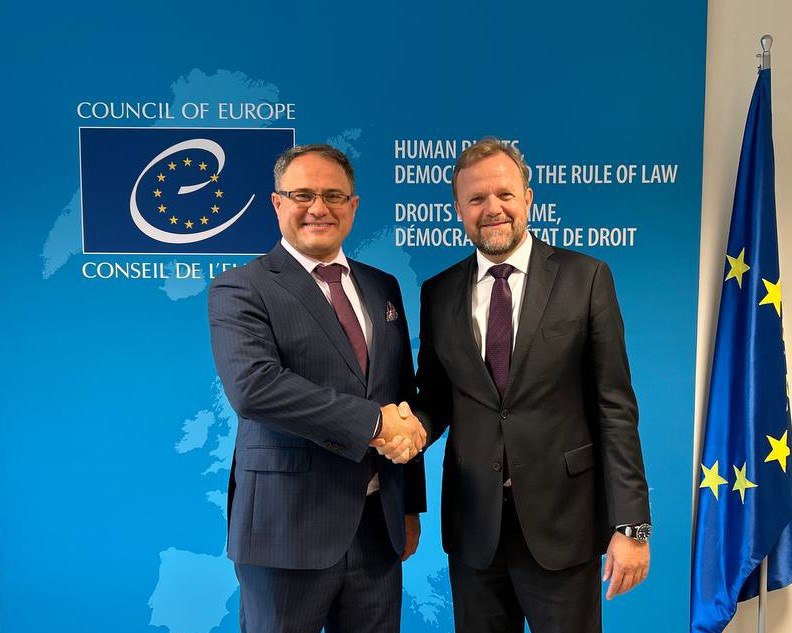
Strasbourg, October 5, 2023 – Deputy Minister of Foreign Affairs of Kazakhstan Roman Vassilenko visited the headquarters of the Council of Europe (CoE), where he met with the leadership of the organization and addressed the meeting of the Group of Rapporteurs on External Relations (GR-EXT) of the Committee of Ministers of the Council of Europe (CMCE).
The European partners were informed about the implementation of political reforms and the new economic course outlined in the state-of-the-nation address of President Kassym-Jomart Tokayev, as well as the initiatives and proposals he announced at the UN General Assembly.
Deputy Secretary General of the Council of Europe Björn Berge, Director of the Program Office of the CoE Klaus Neukirch, Head of Economic Crime and Cooperation Division of CoE Mustafa Ferati commended the reforms being implemented by the President of Kazakhstan, expressing readiness to strengthen cooperation and emphasizing a special regional role of our country in unprecedented geopolitical challenges.
Mustafa Ferrati expressed readiness to assist Kazakhstan in the return of illegally withdrawn assets to the country and supported its intention to accede to the CoE Convention on Laundering, Search, Seizure and Confiscation of the Proceeds from Crime and on the Financing of Terrorism, as well as its plans to establish closer cooperation with the CoE Committee of Experts on the Evaluation of Countermeasures Legalization of criminal income and financing of terrorism (MONEYVAL).
During the GR-EXT Committee meeting a meaningful exchange and discussions took place focusing on the ongoing domestic reforms and the new “Neighborhood Cooperation Priorities between the CoE and Kazakhstan for 2024-2027”. They cover a number of key areas of human rights and internal political development for our country, including conditioned by reforms initiated by the head of state.
In his remarks, Roman Vassilenko noted that since the launch of the Priorities in 2014, Kazakhstan has become a full member in two partial agreements of the CoE – the European Commission for Democracy through Law (Venice Commission) and the Group of States against Corruption (GRECO). He also noted that Kazakhstan is a party to four conventions (On recognition of qualifications related to higher education in the European region; European cultural convention; On laundering, detection, seizure and confiscation of proceeds from criminal activities; and On mutual administrative assistance in taxation).
The partners were informed that the Kazakh authorities are currently considering official invitations to accede to the Convention on preventing and combating violence against women and domestic violence (Istanbul Convention), the Criminal Law Convention on Corruption, and the Convention on Cybercrime. It was highlighted that the current legislation and the legislation in the development stage in Kazakhstan is already 70% consistent with the provisions of the Istanbul Convention.
European officials noted with great interest that the Priorities were drafted in close cooperation with the Kazakh authorities, and are aimed at consolidating the support provided to Kazakhstan in the implementation of democratic reforms and strengthening the rule of law and the system of human rights protection.
Chairperson of the GR-EXT Maria Spasova (Bulgaria) expressed her appreciation of the fact that the fight against domestic violence and violence against women is one of the priorities for the President of Kazakhstan, as it is one of the main priorities for the Council of Europe.
The delegations of Azerbaijan, Cyprus, the Netherlands, France, the United Kingdom, the European Union, and other countries expressed their support for the new Priorities and readiness to provide constant practical assistance in their implementation.
In general, CoE partners welcomed the current level of cooperation between Kazakhstan and the Council of Europe, and confirmed readiness to further cooperation to achieve the common goals of promoting democratic values, human rights and the rule of law. They expressed decisive support for the democratic course of Kazakhstan, which has included constitutional changes, the abolition of death penalty, the expansion of women’s membership in the Parliament, and the strengthening of the power of the Commissioner for Human Rights.
FOR REFERENCE: Groups of Rapporteurs are informal working structures of the CMCE. The main activities of GR-EXT include cooperation with the European Union, OSCE, UN, neighboring regions (countries of North Africa, Middle East, and Central Asia), observer states and non-members. The policy of the Council of Europe in relation to neighboring regions is aimed at expanding cooperation outside the continent, developing a common legal space based on the values and instruments of the organization to promote the stability and democratic security of both Europe and its neighboring countries, and regions. Within this policy, Neighborhood Cooperation Priorities are implemented with Kazakhstan, while there are partnerships with Morocco and Tunisia, as well as regional activities with other countries of the Southern Mediterranean and Central Asia.