Kazakh Foreign Minister Holds Bilateral Meetings on Margins of OSCE Ministerial Council
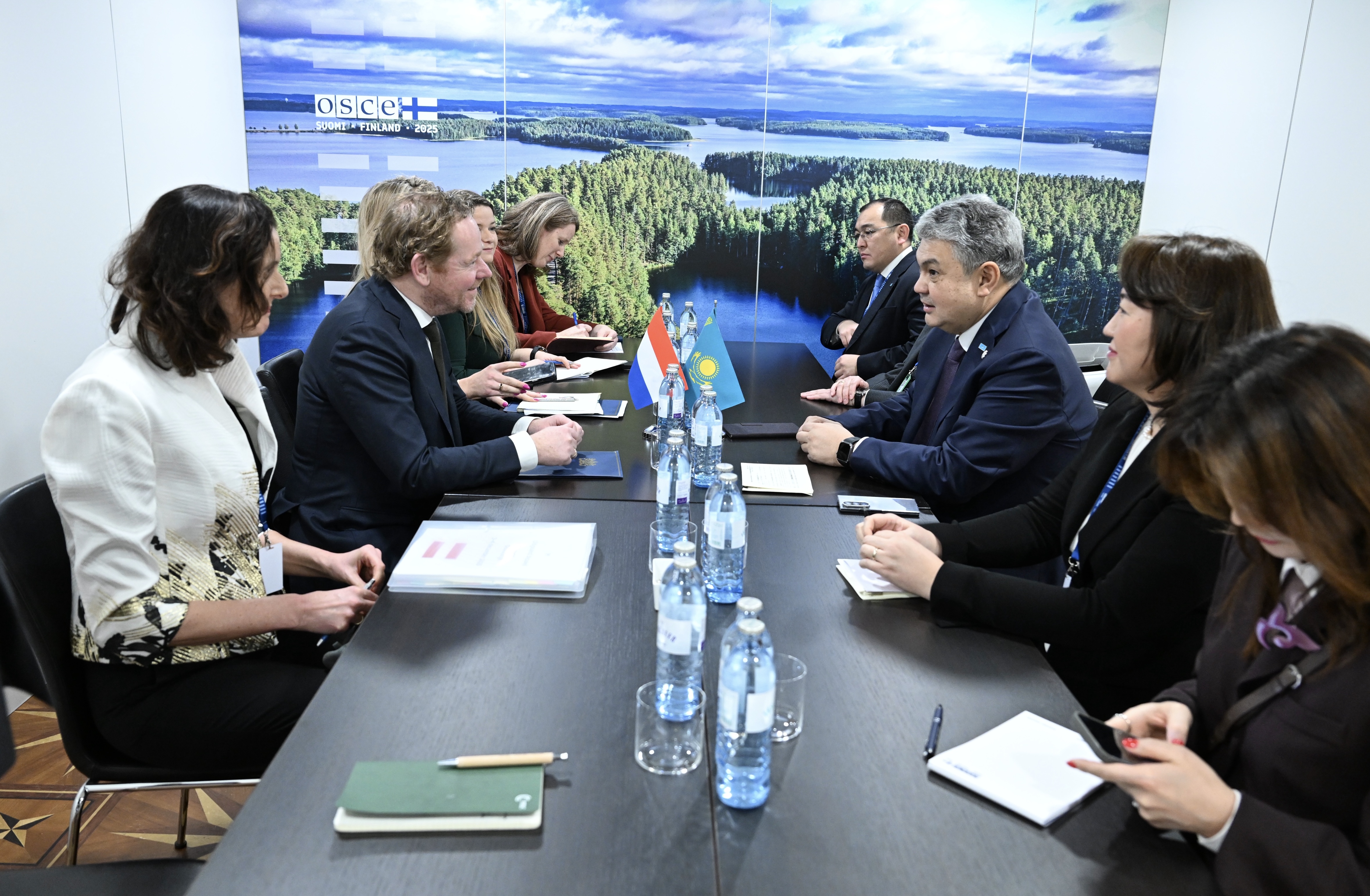
Vienna, December 4, 2025 – On the sidelines of the 32nd meeting of the Council of Foreign Ministers of the Organization for Security and Cooperation in Europe (OSCE), Minister of Foreign Affairs of the Republic of Kazakhstan Yermek Kosherbayev met with the heads of foreign ministries of the Kingdom of the Netherlands, Republic of Cyprus, Republic of Austria, Federal Republic of Germany, the Hellenic Republic, Georgia, and Ukraine.
The talks focused on the priorities of bilateral cooperation, promoting political dialogue, broadening trade and investment partnership and engagement within the framework of the OSCE and other multilateral platforms.
The meeting with Minister of Foreign Affairs of Netherlands, David van Weel, provided an opportunity to review opportunities for strengthening priority sectors and outlined new prospective areas of Kazakh-Dutch trade and investment partnership. The foreign ministers of the two countries affirmed shared interest in strengthening political dialogue and bilateral ties at all levels.
The current state and prospects for the further development of Kazakh-Cypriot cooperation in the political, trade and economic, investment, and cultural and humanitarian spheres were discussed with Minister of Foreign Affairs of Cyprus, Constantinos Kombos. The interlocutors reaffirmed their mutual commitment to continuing constructive dialogue and further strengthening bilateral cooperation.
During the talks with Beate Meinl-Reisinger, Federal Minister for European and International Affairs of Austria, the current state and prospects for the development of Kazakh-Austrian relations were discussed, as well as relevant issues on the international and regional agenda. They underlined the importance of dialogue and facilitating economic cooperation within the framework of bilateral Intergovernmental Commission and the Business Council.
With Federal Minister of Foreign Affairs of Germany, Johann Wadephul, the parties welcomed the outcomes of the latest consultations between the two countries’ foreign ministries, underlining opportunities for further comprehensive strengthening of Kazakh-German ties. The ministers expressed the interest in maintaining regular contacts, broadening inter-ministerial engagement and agreed to deepen ties between Astana and Berlin in all priority sectors.
During the talks with Georgios Gerapetritis, Minister of Foreign Affairs of Greece, the parties reviewed the current state and the potential for further deepening Kazakh-Greek relations. Particular attention was devoted to the dynamics of cooperation in the political sphere, as well as to expanding partnership in the trade, economic, investment, and cultural-humanitarian spheres.
With Minister of Foreign Affairs of Georgia, Maka Bochorishvili, interlocutors discussed current issues on the bilateral agenda, reaffirming their commitment to deepening political dialogue and enhancing trade-economic, transport-logistics, and cultural-humanitarian cooperation. Special attention was given to the prospects for expanding cooperation within the framework of the Trans-Caspian International Transport Route and joint efforts to develop the region’s transit potential.
At a meeting with Ukrainian Foreign Minister Andrii Sybiha, the parties discussed topical issues of bilateral cooperation, paying particular attention to interaction in the political, economic, and humanitarian spheres. The interlocutors confirmed their mutual interest in developing traditionally friendly relations between Kazakhstan and Ukraine and supporting constructive political dialogue. They also exchanged views on regional and international agenda issues, including the role of the OSCE in the Eurasian region.
Following the meetings, the foreign ministers expressed their intention to further advance comprehensive partnership, strengthen inter-agency ties, and promote common approaches to key issues on the international and regional agenda.