ҚР СІМ-нің Қара теңіздегі мұнай танкерлермен байланысты оқиғалар жөніндегі мәлімдемесі
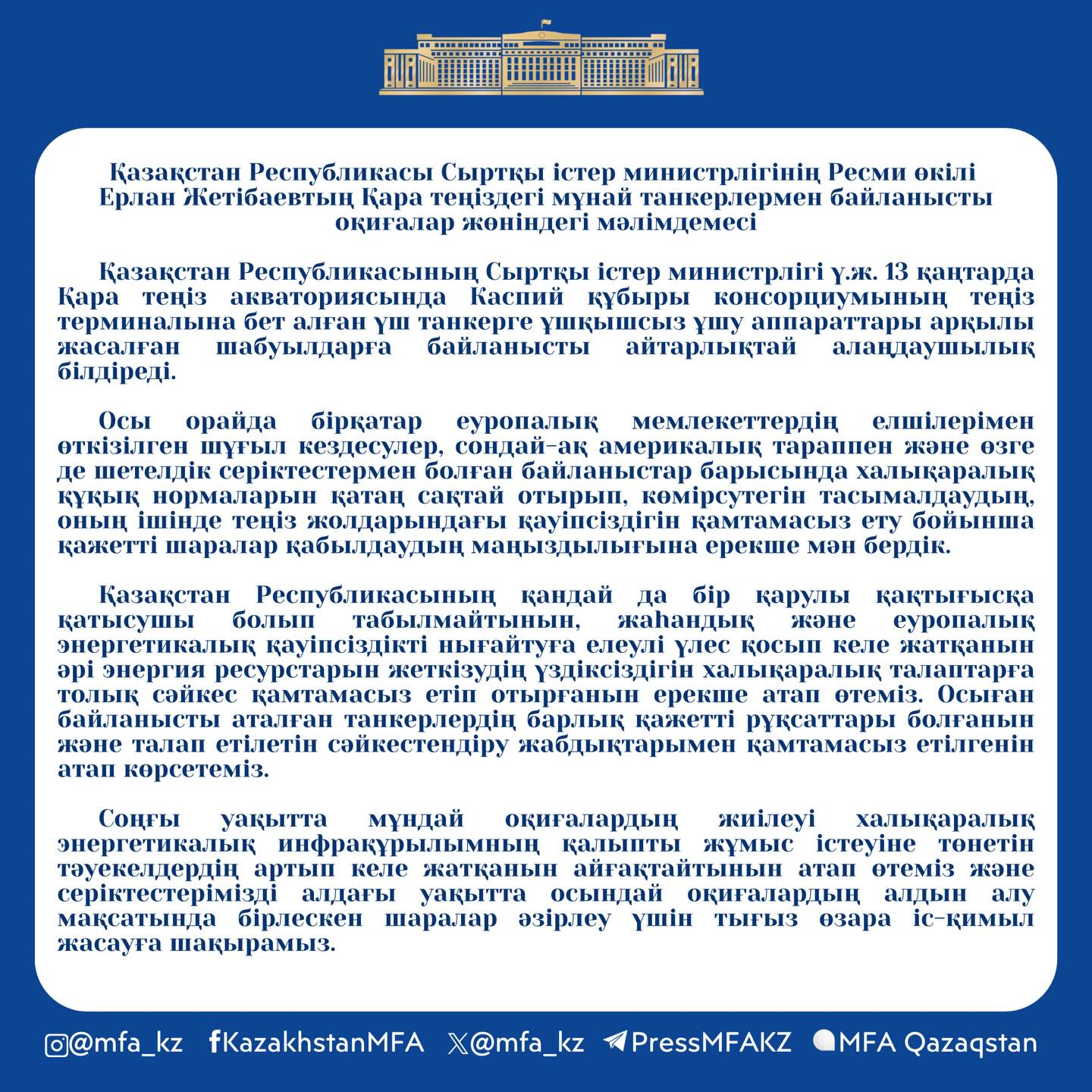
Drone Attacks on Oil Tankers Undermine Safe Maritime Trade and Energy Security
- Series of attacks in the Black Sea on civilian oil tankers linked to Kazakhstan’s main export route have created risks to maritime safety, and brought disruptions in energy supply chains and international trade.
- Attacks on tankers and supply routes set a dangerous precedent, threatening freedom of navigation and the stability of civilian energy infrastructure.
- The Caspian Pipeline Consortium (CPC) is a critical artery for global and European energy markets, carrying more that 80% of Kazakh crude exports.
- Kazakhstan’s position remains anchored in its long-standing advocacy for the rule of law, freedom of navigation and uninterrupted civilian trade.
- Kazakhstan emphasises that disruptions to international energy supply chains affect not only Kazakh producers but also international markets and energy consumers across Europe and beyond.
What Happened
- On 13 January 2026, several oil tankers (Greek tankers “Delta Harmony” – flying the Liberian flag and “Matilda” – flying the Maltese flag) operating in the Black Sea were struck by drones while en route to load crude oil at the CPC Marine Terminal near Novorossiysk.
- The vessels were scheduled to load Kazakh-origin crude oil transported via the CPC, Kazakhstan’s principal export pipeline.
- The attacks resulted in reported damage to the vessels, though no casualties were reported.
- These incidents followed earlier disruptions to CPC operations, including damage to terminal infrastructure and severe winter conditions, which had already constrained oil exports in late 2025 and early 2026.
- As a result, Kazakhstan’s oil exports via the Black Sea have been significantly halted, despite the civilian and international nature of its supplies.
Why This Matters to Europe
The safe and uninterrupted operation of CPC is directly relevant to European energy security and economic stability.
- Kazakhstan ranked third among the largest crude oil exporters to the European Union, exporting around one million barrels per day in recent years. In 2024, almost 1.05 million barrels per day supplied to Europe via CPC, which is equal to 5% of total crude oil imports (roughly one in every nine barrels imported by the EU in 2024 came from Kazakhstan – most of it delivered via tankers loaded in the Black Sea).
- Disruptions affecting CPC, including attacks on tankers linked to CPC loadings, lead to tightening supply, heightened freight and insurance costs, and add volatility to energy markets.
- CPC Blend is a crude grade that many European refineries are configured to process, thus alternative supplies cannot be easily offset.
Beyond immediate supply considerations, attacks on tankers and export routes connected to CPC raise broader concerns about the security of civilian maritime trade. Moreover, difficulties in securing stable, diversified oil imports tend to increase Europe’s economic costs. For Europe, maintaining freedom of navigation and the protection of civilian infrastructure is essential to ensure stable supplies and prevent wider economic disruption.
Kazakhstan’s Position on Attacks on CPC-Related Infrastructure and Shipping
Kazakhstan regards the safety and uninterrupted operation of civilian energy infrastructure and maritime trade routes as essential to global energy markets and regional stability. The CPC is a civilian export artery that supports not only Kazakhstan’s economic interests but also energy supplies to Europe and other markets. Kazakhstan has consistently affirmed that attacks on CPC infrastructure and associated commercial shipping undermine these shared interests and violate established norms of international law.
- Kazakhstan has expressed formal protest against repeated attacks on CPC infrastructure, emphasising that the pipeline and its marine terminal are exclusively civilian facilities whose operation is safeguarded by international legal norms.
- In previous incidents affecting the CPC Black Sea terminal, Kazakhstan conveyed through diplomatic channels its expectation that all parties respect the integrity of critical export infrastructure and take measures to prevent harm to third-party interests.
- The Government has reiterated its commitment to maintaining open communication and pursuing de-escalation through diplomatic engagement, while safeguarding its sovereign economic interests and the safety of its citizens and economic partners.
- Kazakhstan continues to call for the protection of civilian shipping and energy export infrastructure from attacks that disrupt trade and have broader implications for regional economic stability.
What is the Caspian Pipeline Consortium
The CPC is the principal export route for Kazakhstan’s oil, connecting the country’s major producing regions in western Kazakhstan with international markets via the Black Sea. The pipeline runs for approximately 1,500 kilometres to the CPC Marine Terminal near Novorossiysk, where crude is loaded onto tankers for onward shipment.
- It is operated as international consortium, reflecting its role as a cross-border, civilian energy infrastructure serving global markets.
- CPC is the main export artery for Kazakhstan’s oil sector, carrying around 80% of Kazakhstan’s total crude exports under normal operating conditions.
- The pipeline transports oil from Kazakhstan’s largest fields, including Tengiz, Kashagan and Karachaganak. In terms of reserves and cash flow, these assets form the core of the oil majors, including American Chevron and ExxonMobil as well European ENI, Shell and TotalEnergies, with estimated cumulative free cash flow over $50 billion in 2025-2030. In particular, around 20-25% of Chevron and ENI’s proven reserves are concentrated in Kazakhstan.
- Based on the official financial reporting of ENI S.p.A., with total investments amounting to approximately $22 billion, the income generated is estimated at around USD 10-10.5 billion, which confirms ENI’s strategic commitment to the sustainable development of its projects and to the further expansion of cooperation with the Republic of Kazakhstan.
- CPC exports are highly Europe-oriented, with the CPC Blend being widely traded and refined in Europe and beyond.
- In normal conditions, CPC handles volumes equivalent to more than 1% of global oil supply. Last year CPC exported as much as 1.7 million barrels a day of crude, but loadings in January are set to be between 800-900 thousand barrels a day. Planned shipments have already plunged due to bad weather and damage caused by previous drone attacks.
Recent Disruption Timeline
- 17 February 2025 – A drone strike hit the Kropotkinskaya pumping station (Russia), a key facility on the CPC pipeline route, forcing the system to operate without the station and reducing throughput while repairs were planned.
- September–November 2025 – A series of drone-related incidents near Novorossiysk (Russia) affected CPC’s Black Sea export infrastructure, including strikes near CPC facilities and temporary halts to oil loadings during air-raid alerts.
- 29 November 2025 – A drone attack damaged a key mooring at the CPC Marine Terminal at Yuzhnaya Ozereyevka (Russia), disrupting loadings and reducing export capacity for Kazakh oil.
- 13 January 2026 – Multiple oil tankers were struck by drones in the Black Sea while en route to load Kazakh crude at the CPC terminal, further escalating risks to shipping linked to the export route.
Operational and Market Impact
- Repeated disruptions have constrained Kazakhstan’s ability to export crude oil via its main route, affecting volumes reaching international markets.
- Limited alternative export options mean that even short-term interruptions at CPC have immediate effects on production, storage and shipment schedules.
- Attacks on tankers linked to CPC loadings have increased maritime risk in the Black Sea, with potential implications for shipping availability, insurance costs and freight rates.
- Reduced CPC throughput has contributed to tighter supply conditions for CPC Blend, a crude grade widely used by European refiners.
- Continued instability around CPC operations risks greater volatility in regional and global oil markets, particularly at a time when European energy systems remain sensitive to supply disruptions.
Together, these factors highlight the importance of protecting civilian energy infrastructure and maritime trade routes to ensure stable energy supplies and predictable market conditions.