President Tokayev Unveils Package of Political Reforms at National Kurultai
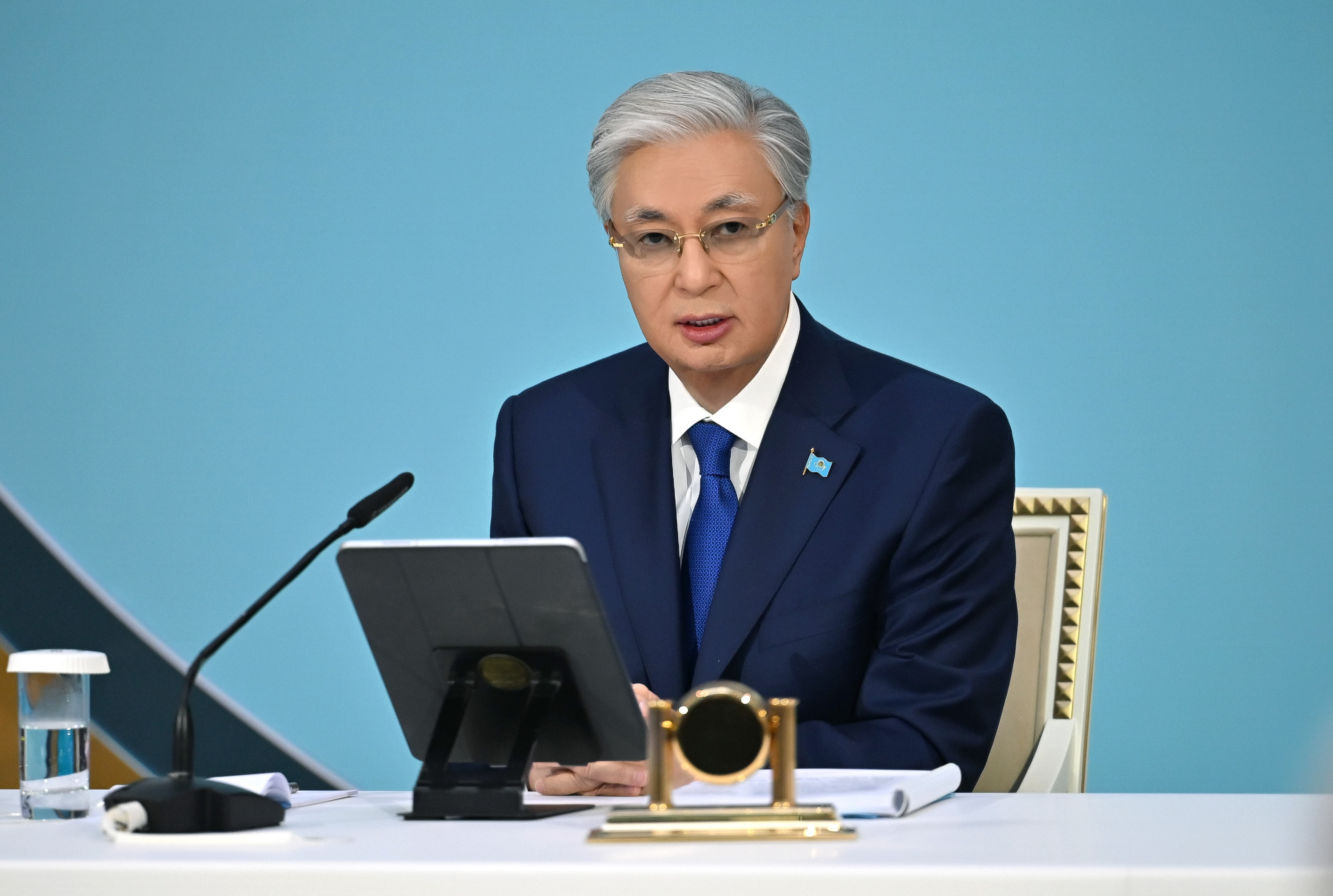
Factsheet on President Kassym-Jomart Tokayev’s Speech at the National Kurultai
Overview
On 20 January 2026, President Kassym-Jomart Tokayev addressed the National Kurultai (Congress) held in Kyzylorda, outlining a new stage in Kazakhstan’s political development, alongside priorities in foreign policy, economic governance and digital transformation.
In his speech, President Tokayev presented a package of constitutional and institutional reforms aimed at modernising the state system, clarifying governance architecture and strengthening long-term political stability. Central to the address were proposals to formalise presidential succession rules, establish the position of Vice President, and transition to a fundamentally new constitutional model following a national referendum.
The President also addressed Kazakhstan’s foreign policy posture in a changing global environment, reaffirming a balanced, pragmatic and interest-driven diplomacy, as well as economic integration priorities, food security concerns, and the strategic importance of digitalisation and artificial intelligence for national competitiveness.
President Kassym-Jomart Tokayev’s Speech
Key Points of Specific Interest to Europe and the United States
Foreign Policy in a Changing Global Environment
- Kazakhstan’s foreign policy must remain balanced, cautious and firmly anchored in national interests.
- He stressed that diplomatic decisions carry long-term consequences and must be made with professionalism and restraint.
- Diplomacy, he said, should function as a tool for compromise rather than confrontation, reinforcing Kazakhstan’s role as a predictable and responsible international actor.
Human Rights, Rule of Law and Civic Responsibility
- President Tokayev reaffirmed Kazakhstan’s commitment to building a rule-of-law state, emphasising that legal reform must go hand in hand with the strengthening of civic responsibility and national self-awareness.
- He highlighted the impact of the 2022 constitutional reforms, including the establishment of the Constitutional Court, the creation of cassation courts, and the granting of constitutional status to the Human Rights Commissioner (Ombudsman), as key steps in strengthening the protection of citizens’ rights.
- The President noted that reforms to administrative justice and judicial procedures have improved citizens’ and entrepreneurs’ ability to defend their lawful interests before the courts.
- He reiterated the state’s obligation to protect the rights, freedoms, dignity and security of all citizens.
Key Points of Specific Interest to Russia and the CIS
Economic Integration and Protection of National Interests
- President Tokayev reaffirmed Kazakhstan’s support for economic integration, while stressing that it will firmly defend its national interests, particularly amid global trade tensions.
- As chair of the Eurasian Economic Union (EAEU) in 2026, Kazakhstan will prioritise:
- Elimination of trade barriers
- Combating unjustified protectionism
- Expanding the use of artificial intelligence to improve integration efficiency
Key Points of Specific Interest to China and Asia, including Central Asia
Transport Connectivity and Transit Potential
- President Tokayev reaffirmed Kazakhstan’s ambition to position itself as a key international transport and logistics hub connecting East–West and North–South corridors.
- Major highway and railway projects were announced to accelerate the development of Middle Corridor.
- Kazakhstan aims to significantly strengthen cargo aviation, with the President signalling openness to greater private-sector involvement to improve competitiveness, including on jet fuel pricing.
Energy, Water Security and Environmental Diplomacy
- President Tokayev identified water as a strategic national and regional resource.
- He reminded that Kazakhstan will host the International Ecological Summit in Astana in April, focused on the Aral Sea.
- He instructed QazaqGaz, the Government and the Samruk-Kazyna Fund to accelerate geological exploration, develop new gas fields using a mix of state and private investment, and strengthen oversight of major gas-processing projects.
Additional Key Points of Significant Interest
Introduction of the Office of Vice President
- The Vice President would represent Kazakhstan internationally, engage with Parliament, work with domestic and foreign organisations, and perform duties assigned by the President.
- These responsibilities would be explicitly enshrined in the Constitution, providing legal clarity and institutional stability.
- The President stressed that this reform is intended to strengthen governance coherence, not dilute presidential authority. Kazakhstan will continue to function as a presidential republic.
Clear Constitutional Rules for Presidential Succession
- President Tokayev underscored the importance of unambiguous constitutional regulation of presidential succession.
- In the event of early termination of a presidential term, presidential elections must be held within two months, ensuring that any head of state comes to power exclusively through elections.
- He described this principle as fundamental and non-negotiable, reinforcing Kazakhstan’s commitment to electoral legitimacy and political predictability.
Transition to a New Constitutional Model and Strengthening Checks and Balances
- It is proposed that the appointment of members of the Constitutional Court, Supreme Audit Chamber and Central Election Commission be carried out exclusively with the consent of Parliament.
- Parliament would also receive the power to elect all judges of the Supreme Court upon nomination by the President, marking a significant step in strengthening checks and balances between branches of power.
Reconfiguration of Parliamentary and Advisory Institutions
- The proposed reforms include a move toward a unicameral parliament (to be called “Kurultai”), designed to streamline legislative processes and governance efficiency.
- The new Parliament is proposed to consist of 145 deputies, with up to three deputy speakers and no more than eight standing committees, prioritising efficiency and professionalism over numerical expansion.
- Deputies will be elected exclusively on a proportional basis, strengthening the institutional role and responsibility of political parties. Deputies will be elected for a five-year term, with a revised three-stage legislative procedure: conceptual approval, amendment approval, and final adoption of laws.
- A new Khalyk Kenesi (People’s Council) would be established, assuming key functions of the Assembly of the People of Kazakhstan in the areas of interethnic and interfaith harmony.
- The People’s Council would also:
- Develop proposals to improve domestic policy
- Promote and explain matters related to state ideology
- Be granted the right of legislative initiative
- Organise the Congress of Leaders of World and Traditional Religions and other major humanitarian forums
- The reforms also envisage the abolition of certain administrative structures supporting the current Parliament, the elimination of the post of State Counsellor, and adjustments to the Presidential Administration to better reflect practical governance needs.
Digitalisation and Artificial Intelligence
- Kazakhstan, he said, has chosen a path of accelerated digital and AI adoption across all sectors of the economy and public administration.
- He called for the early designation of zones for high-capacity data centres, equipped with:
- Reliable power supply
- Advanced cooling systems
- Robust physical and cyber security
- The President supported the creation of a national digital repository of memory and knowledge, (National Digital Heritage), aimed at systematising archival materials, museum collections, scholarly research and works of art in digital form.
Cultural and Spiritual Development
- The President underscored the importance of promoting Kazakhstan’s cultural and historical heritage internationally, including through UNESCO mechanisms, noting Kazakhstan’s strong standing in the number of elements inscribed on UNESCO’s Intangible Cultural Heritage list.
- He stressed the need to deepen scholarly research into Kazakhstan’s history and civilisation, including the publication of a seven-volume academic history of Kazakhstan, and the organisation of international conferences on the Golden Horde and Turkic civilisation.