Summary of the analytical report. Reforms in Kazakhstan: from Intentions to Actions
Summary of the analytical report “Reforms in Kazakhstan: from Intentions to Actions. New course of President of the Republic of Kazakhstan Kassym-Jomart Tokayev”
Overview
This document presents a summary of the analytical report “Reforms in Kazakhstan: from Intentions to Actions. New course of President of the Republic of Kazakhstan Kassym-Jomart Tokayev”. The report assesses political and socio-economic changes taking place in Kazakhstan.
Foundation for the reforms
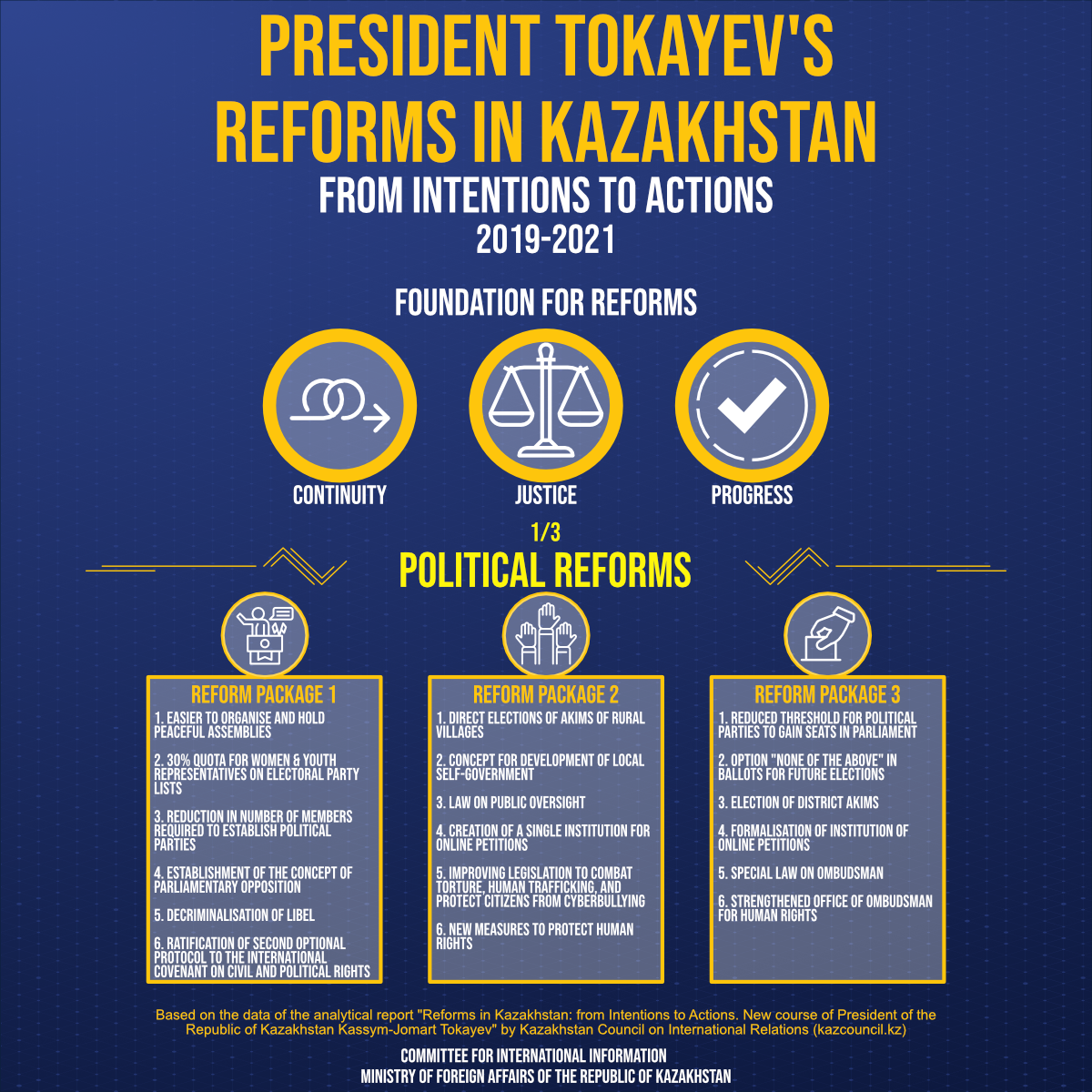
In his presidential campaign, Kassym-Jomart Tokayev designated the following three key principles of his future political course:
- Continuity - the effective continuation of the political course set by First President Nursultan Nazarbayev, and the preservation of all positive achievements.
- Justice - equality of rights for all citizens, regardless of their social, ethnic, religious, or other affiliation.
- Progress – social renewal in all spheres of society; the implementation of constructive changes for the benefit of people with the aim of becoming one of the leading countries of the world.
Economic reforms proceed from the need for the national economy to increase the well-being of the population and an equitable distribution of national income. On this basis, the Head of State outlined the following key principles of the country's new economic course:
- Equitable distribution of benefits and responsibilities
- The leading role of private enterprise
- Fair competition, opening up markets for a new generation of entrepreneurs
- Increased productivity, increased complexity and technological effectiveness of the economy
- Development of human capital, investment in a new type of education
- Greening the economy, protecting the environment
- Public accountability
The National Council of Public Trust
The National Council of Public Trust was established in June 2019. Its main goal is to develop proposals and recommendations on issues of state policy based on a broad discussion with representatives of the public.
Political reforms
Three packages of political reforms
The first package of political reforms announced by the Head of State in December 2019 has been fully implemented. It includes:
- The Law on the Procedure for Organising and Holding Peaceful Assemblies, which replaced the previous principle of granting permission to hold assemblies with that of notifying authorities of the planned peaceful assemblies
- The Constitutional Law on Amendments to the Constitutional Law of Kazakhstan on Elections in Kazakhstan, which established a 30% quota for women and youth representatives on electoral party lists
- The Law on Amendments to the Law of Kazakhstan on Political Parties, which reduced the number of members required for the establishment of political parties from 40,000 to 20,000 people.
- The establishment of the concept of the parliamentary opposition, which ensures that opposition parties represented in the Mazhilis are guaranteed the chairmanship of one standing committee and position of Secretary for two standing committees of the Chamber
- Decriminalization of Article 130 of the Criminal Code of Kazakhstan on Libel
- Ratification of the Second Optional Protocol to the International Covenant on Civil and Political Rights aimed at the abolition of the death penalty
The second package of political reforms includes the following measures:
- Direct elections of akims (mayors) of villages in 2021
- Development of the Concept for the Development of Local Self-Government
- Development and adoption of the Law on Public Oversight designed to ensure greater openness and accountability of government agencies and quasi-public sector
- Creation of a single institution for online petitions
- Improving legislation to combat torture, human trafficking, and protect citizens (especially children) from cyberbullying
- Adopting new measures to protect human rights, and joining the Optional Protocol to the Convention on the Rights of the Child on a Communications Procedure
A third package of political reforms contains the following measures:
- Reduce the threshold for political parties to gain seats in the Mazhilis from 7% to 5%
- Introduce the option "none of the above" in the ballots for all future elections
- After the introduction of elections of rural akims, Kazakhstan will then proceed to the election of district akims
- Legally formalise the institution of online petitions
- Adopt an additional law on the ombudsman
- Strengthen the Office of the Commissioner for Human Rights (including the creation of its regional offices)
- Implementation of the Youth Development Index
- Provide measures to stimulate the activities of charities
- Further improve the system of public oversight
Additional measures
- The Concept of the Civil Society Development in Kazakhstan, which create conditions for the development of civil society and its institutions, and supports and development of civic engagement
- The establishment of public councils in the entities of the quasi-public sector
- Drivers of vehicles who are citizens of Kazakhstan are no longer required to have with them their driver's license, a registration certificate, insurance policy and vehicle inspection certificate
- The Law on Amendments to Some Legislative Acts of Kazakhstan on Counteracting the Legalization of Illegally Obtained Incomes and Financing of Terrorism
Modernization of Public Administration
- The Civil Service Affairs and Anti-Corruption Agency was reorganised and divided into the Civil Service Affairs Agency and the National Anti-Corruption Bureau
- A new Ministry of Trade and Integration and the Ministry of Ecology, Geology and Natural Resources were established in June 2019
- The Ministry of Digital Development, Defense and Aerospace Industry was transformed into the Ministry of Digital Development, Innovation and Aerospace Industry
- The Syrbar Foreign Intelligence Service was merged with the National Security Committee
- The Central Communications Service was established under the President of Kazakhstan
- The Division for Monitoring the Consideration of Appeals of the Administration of the President of Kazakhstan was created in July 2019
- The Agency for Regulation and Development of the Financial Market was created in November 2019
Renewal of public human resources
To renew the personnel of various leadership positions in the system of public authorities and management, the Head of State initiated the formation of the Presidential Youth Personnel Reserve.
Additional measures in 2020
- Creation of the Supreme Council for Reforms under the President to consider and make decisions on the implementation of new reforms
- Creation of the Agency for Strategic Planning and Reforms to prepare materials and proposals for the formation of reforms and to assist in their effective implementation
- Creation of the Ministry for Emergency Situations in order to improve the efficiency of the Ministry of Internal Affairs by exempting it from non-core functions
- Creation of the Agency for Protection and Development of Competition to create equal conditions for market participants by protecting and promoting competition, limiting monopolistic activities and preventing unfair competition
- Reorganization of the Committee on Statistics of the Ministry of National Economy into the Bureau of National Statistics of the Agency for Strategic Planning and Reforms
- Abolishing the institution of responsible secretaries of Ministries to increase the responsibility of Ministers for the activities of their organization
- Reduction of the number of civil servants by 25% by the end of 2021
- Introduction of the factor-point scale of remuneration of civil servants from July 2021, designed to strengthen their responsibility and motivation
Measures in 2021
- Creation of the Financial Monitoring Agency to fight against the "shadow" economy, with the aim of reducing its level to 15% by 2025
- Establishment of a new State Planning System, designed to build a more flexible architecture of program documents, and establish direct responsibility of the heads of state bodies and organizations for the implementation of plans and programs
- Development of the Concept of Public Administration Development of Kazakhstan through 2030, designed to ensure the transition from an administrative orientation to a service model of interaction between the state and the population
Economic reforms
- Improving Taxation, Land-Use, and Foreign Labor by imposing a moratorium on the creation of new state-owned companies and quasi-public sector entities, exempting micro and small business entities from paying taxes and the introduction of a ban on their inspections by authorised state bodies for 3 years, postponing the introduction of mandatory payment by employers of a 5% contribution to the Unified Accumulative Pension Fund until 2023, introducing non-cash payments and the development of non-bank payment systems, ordering to seize unused agricultural land from irresponsible landowners, introducing a 40% reduction in the quota for attracting foreign labor, conducting annual inspections at enterprises that attract foreign labor, and developing by the Ministry of Finance and the National Bank of the Unified Register of external debt in the form of a digitised database.
- Industrial Policy, Foreign Investment, Regulation, including:
- Development and adoption of the Law on Industrial Policy, designed to define the basic principles, goals and objectives of the development of the manufacturing industry
- Implementation of the new Support Instrument for Investors
- Development and adoption of a law regulating the procurement of the quasi-public sector
- Development of a new national project to develop the agro-industrial complex through 2026
- Development of a new regulatory framework for small and medium-sized business activities aimed at changing the regulatory policy
- Implementation of the export accelerator program aimed at supporting medium-sized non-resource enterprises in order to expand access to foreign markets
- Measures to reorient the excess liquidity of second-tier banks to lending to SMEs and to stop currency speculation
- Conducting an audit of the Tax Code and regulations thereunder to minimise the number of taxes and payments
- Simplification of the execution of tax obligations, including through digitalization
- Improving international taxation to strengthen controls on capital outflows and to encourage reinvestment of profits in the country
- Implementation of the “expanded budget” covering the activities of extra-budgetary funds
- Adoption of measures to improve the regulation of commodity exchanges
- Formation of a legislative mechanism for public administration of the activities of public and private operators authorised to perform certain economic functions and provide monopolistic services
- Reduction of unproductive costs and redundant subsidiaries in the quasi-public sector
- Creation of the unified development institution by combining government-owned financial organisations “Baiterek” and “KazAgro”
Social reforms
- Social Protection of the Population, including by:
- adopting the Decree on Measures to reduce the debt burden of Kazakh citizens, according to which the government and the National Bank were instructed to repay the debts on loans of low-income citizens in second-tier banks and microfinance organizations
- introducing the opportunity for interested citizens of the country to use their pension savings to improve housing conditions and pay for medical treatment
- Introducing mechanisms for subsidising rent payments and expansion of work on providing land plots for individual housing construction with communication lines
- Creating 12 social rehabilitation centers for persons with disabilities
- Healthcare reforms, including: creating a unified digital healthcare space with the inclusion of 90% of medical organizations, approving the Comprehensive Plan for the Development of the Pharmaceutical and Medical Industry for 2020-2025 designed to increase the share of national manufacturers in the domestic market of essential pharmaceutical products from 39% to 50%, launching the special program "Ansagan Sabi" commencing from 2021 with the provision of 7000 quotas for In Vitro Fertilization (IVF), ensuring that by 2023 the level of wages of medical workers is 2 times higher than the average wage in the economy, determining the list of basic medicines and medical products that should be produced in Kazakhstan and adoption of appropriate measures to achieve this goal, taking measures to strengthen transport medicine to serve remote regions, providing all remote and nearest inhabited localities with medical and obstetrical stations and outpatient clinics in the next 3 years, and forming a ten-year forecast for the provision of medical institutions with personnel
- Education reforms, including:
- Increasing salaries for teachers and university lecturers, and increasing scholarships for future teachers from 26,000 to 42,000 tenge
- Introducing a special exam for potential teachers
- Gradual digitalization of school textbooks by the Ministry of Education and Science
- Establishment of a single integrated online educational platform
- Measures to create equal opportunities for children to receive a quality education
- Measures to support secondary schools to bridge the gap between urban and rural education
- Development of the Concept of lifelong learning (continuous education)
- Allocation of 500 grants to provide scientists with internships in leading scientific centers of the world