Aset Irgaliev presented to the Government a new package of anti-crisis measures to support business
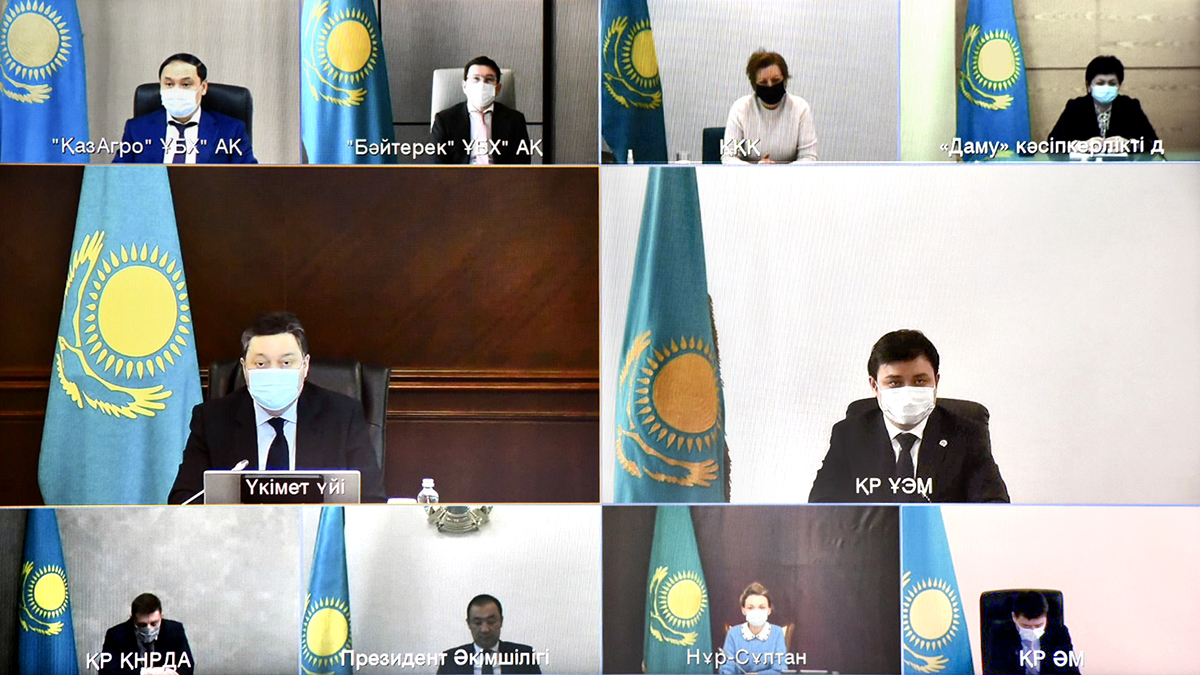
Today, during a meeting of the Project Office on Entrepreneurship, chaired by Prime Minister of Kazakhstan Askar Mamin, Minister of National Economy Aset Irgaliev spoke about anti-crisis measures to support business and the population in 2020, and also presented a package of new business support tools.
The Minister stressed that we are talking about three packages of anti-crisis measures, including urgent measures to support the population and business, to maintain socio-economic stability and a Comprehensive Plan to restore economic growth.
In order to support business, tax incentives were provided for the affected industries, concessional lending to SMEs was expanded, and financing of working capital was increased. In addition, loans were refinanced on preferential terms and payments on them were deferred. As a result, 700,000 entrepreneurs received tax breaks, 80% of borrowers from affected industries took advantage of loan deferrals, and 40,000 entrepreneurs took advantage of project financing.
It is worth emphasizing that in 2020, changes were made to the business support program, which made it possible to expand lending instruments and the availability of financing. Thus, according to the Business Roadmap and Economy of Simple Things program, the interest rate has been unified at the level of 6%.
The head of the Ministry of National Economy recalled that from January 1, 2020, there is a three-year moratorium on inspections in relation to micro and small businesses. The moratorium will allow canceling 100,000 inspections within three years, which will reduce the administrative burden and contribute to the stability of the business launch.
“A new program of concessional lending of the National Bank has been launched to provide working capital at a rate of 8% for affected business entities, industry restrictions have been lifted under the“ Business Roadmap ”program,” A. Irgaliev noted.
In addition, within the framework of the “Business Roadmap-2025”, a new direction “Microcredit for business” was introduced. End borrower rate is 6%. The maximum amount of microcredit for replenishment of working capital is 5 million tenge, for production needs - 20 million tenge. At the same time, guarantees of up to 85% of the principal debt are provided by the state, as well as projects of micro and small businesses are being rapidly considered.
According to Aset Irgaliev, 8 urgent new measures aimed at supporting business have been developed and considered at the Supreme Council for Reforms.
First. Reducing the burden on the wages fund and payment in a single payment for SMEs.
Second. To support the establishment and development of new manufacturing enterprises, it is proposed to consider the issue of reducing (by 2 years from the date of establishment of the enterprise) VAT for them by 70%.
Third. For the development and support of enterprises, an exemption from corporate income tax is proposed for profits that will be reinvested in the development of production.
Fourth. Expansion of the list of priority activities for the conclusion of investment agreements by the Government.
Fifth. Simplified registration of individual entrepreneurs through a free mobile application.
Sixth. During the current year, it is proposed to reduce all business requirements by a third.
Seventh. To increase the availability of business financing, it is proposed to include microfinance organizations in the subsidy program "Business Road Map - 2025".
Eighth. It is proposed to introduce a retail tax regime for the catering sector in SMEs.
“These measures are planned to be introduced already this year, which will allow by 2025 to involve 500 thousand employees in official employment, to increase investments in the manufacturing industry by 15 percentage points. annually, to reduce the shadow economy to 15% of GDP, taking into account the implementation of the Plan to reduce the shadow economy, as well as reduce the burden on the wage fund for 75% of micro and small businesses,” concluded the head of the economic department.