In the footsteps of hanguls
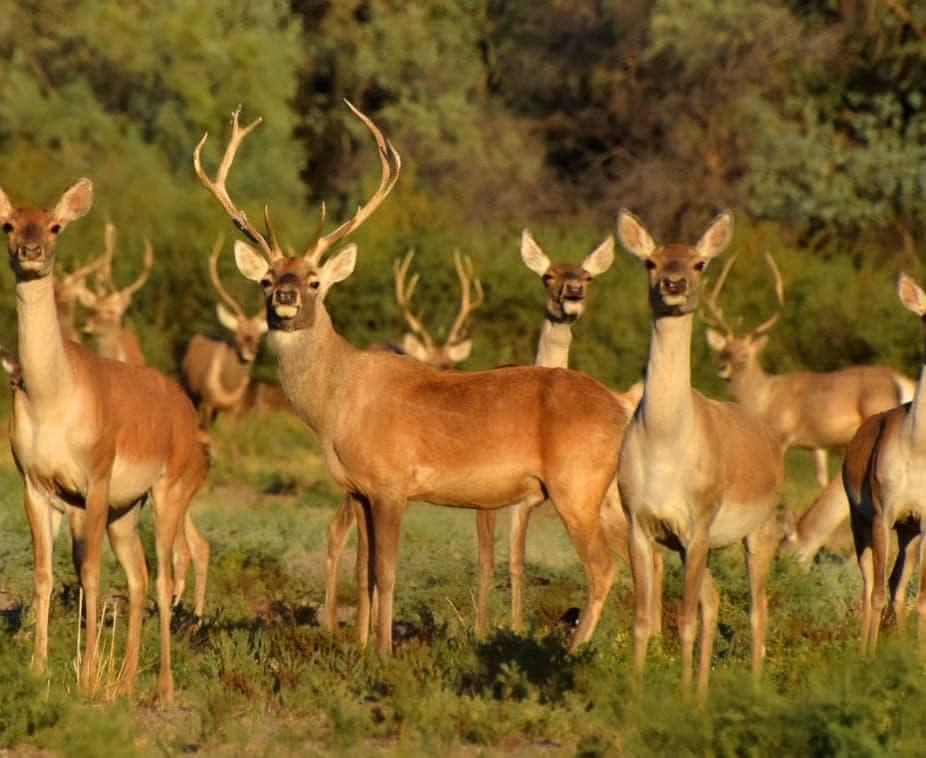
From ancient times until half of the last century, the dense tugai thickets of the Syrdarya were inhabited by Bukhara deer. By 1956, as a result of collectivization, development of arable land, uncontrolled hunting, the tugai deer and Turkestan tiger living on the banks of the Syrdarya and Ili disappeared for good.
The scientific name of the Bukhara deer (Cervus elaphus bactrianus). It is also referred to as a hangul, a water deer, a tugai deer. All these names speak exactly about this kind of deer.
HANGULS RETURNED TO THEIR HABITAT
By the 60s of the twentieth century, hanguls remained only in the reserves "Tigrovaya Balka" and "Aral-Paygambar". By that time, about 400 individuals were counted in the Darganat Gorge, located in Tajikistan. Throughout Central Asia, the growth of deer up to one thousand heads was noticed by the 80s. With the acquisition of the sovereignty of the Central Asian countries, during the perestroika and the Tajik-Afghan conflict, the number of horned cattle again decreased to 350. Now humanity was faced with the task of preserving this species of mammals.
In Kazakhstan, the practice of reintroduction of deer dates back to 1981. That year, 22 deer were brought from Tajikistan to the territory of the hunting farm "Karashengel", located on the banks of the Ili River in the Almaty region. By the beginning of the XXI century, there were already 300 heads.
In 2000, the World Wildlife Fund (WWF) developed a program to settle Bukhara deer in their native habitat and increase the number of livestock. The program developed in three directions, one of which was the reintroduction of Bukhara deer to their historical homeland in the middle reaches of the Syr Darya. Thanks to this program, a nursery was built on the territory of 2 hectares in the Kyzylsharua forestry 50 km from Turkestan. With the support of WWF, 3 individuals were brought to this nursery on May 31, 2001, and in November 2003 another 6 heads of Bukhara deer from the Karashengel hunting farm. In the winter of 2005, due to the flood, which created a threat of flooding, deer, which have already become 16, are transported to the Shymkent zoo. Hanguls return to the nursery two years later in the amount of 19 heads. Their number is supplemented by 12 individuals in 2009, imported from the same "Karashengel". In the same year, 2 males and 8 females are released into the natural environment.
The creation of the Syrdarya-Turkestan Regional Nature Park in 2013 played a key role in increasing the population of tugai deer. The nursery area has been expanded to 22 hectares.
In 2017, another Bukhara deer nursery "Shogirli" was created on the territory of the Arys branch, with an area of 20 hectares. Currently, 94 deer are kept in both nurseries, 89 in the wild. It is planned to release the next batch into the wild in the near future. And now there are 8 deer in the Shogirli nursery.
WHY ARE THE KYZYLORDA FORESTERS NOT INTERESTED IN THE FATE OF THE RED BOOK ANIMALS?
Studies have shown the geography of the distribution of Bukhara deer, which in the south begins near the village of Kogam in the Otyrar district of Turkestan region and reaches the Zhanakurgan and Shieli districts of Kyzylorda region, in the north. The exact, at least approximate, number of deer is unknown due to the irresponsible attitude towards animals of employees of environmental institutions of the neighboring region.
Employees of the regional nature park together with inspectors of the RCMM "Okhotzooprom" conducted surveys and identified the places of distribution of hanguls in the territory of the Kyzylorda region.
Observation post No. 1
Zoological reserve "Kargaly".
The data of the inspectors of the RO RCMM "Okhotzooprom" and the testimony of a preliminary survey of residents on the territory of the zoological reserve "Kargaly" of the Karatau reserve located in the Shieli district confirmed the presence of animals similar to Siberian roe deer, but larger in size. Based on this information, a reconnaissance was carried out in the area of the Akdon cordon of the Kargaly Reserve.
On the bank of the Syrdarya River (coordinates 43.946121, 66.839015) traces similar to the tracks of Bukhara deer were found. A distinctive feature of the gait betrayed the owners of the tracks. They were deer. The tracks leading to the watering hole did not go back.
The many-cut tracks gave away the presence of deer on the Koktal Peninsula, as well as on the shore of antiquity. It can be concluded that this site, located on the land of the Kargaly Nature Reserve, protected by rangers, on the one hand, and bordered by the fence of the Kazatomprom deposits, on the other hand, created favorable conditions for increasing the horned population. An example of this is the greater number of Siberian roe deer, wild boar, badger, hare, Syrdarya pheasant, which make up the main fauna of the Kargaly reserve, compared with neighboring regions. The preservation of turang groves and reeds, which are the main diet of Bukhara deer, also play an important role. Summing up the facts, the researchers came to the conclusion that about 4-5 individuals constantly live in this place.
ABUNDANCE OF DEER TRACKS IN ZHANAKORGAN
Observation post No. 2.
Besaryk Bridge across the Syrdarya.
During the investigation of the place near the Besaryk Bridge in the Zhanakorgan district, numerous traces and droppings of Bukhara deer were found. The villagers even managed to capture their photos. According to a native of the village of Besaryk Kenzhebek Shemetov, a couple of hanguls, he regularly saw the mausoleum of Aikozha Ishan and the island of Adai in the area (coordinates 43.556615, 67.493777). Compared to the traces found in the Shieli district, there are much more of them. Consequently, about 7-8 deer live here.
Observation post No. 3.
The village of Kelintobe, Lake Sharapa.
This corner turned out to be a real favorite place of Bukhara deer. Starting from the outskirts of the village of Kelintobe to the extreme point of Ubmet Island, all the facts proved the existence of a large number of Bukhara deer in this area. Deer tracks dotted from the edge of the Tugai to the pond. Umbet Island, 15 kilometers long, is densely covered with turang groves and endless thickets of reeds, which is an ideal habitat for deer. However, Umbet Island and Sharap Lake are privately owned. Private rice fields are also a favorite place to visit for deer, as evidenced by the stories of Aulchans.
In general, it can be assumed that the coast of the Syr Darya in the Zhanakorgan district is completely inhabited by Bukhara deer. However, the nature conservationists of the Kyzylorda region, being informed about the presence of hanguls on the territory, are in no hurry to keep records of them. Bukhara deer - refers to an endangered species of animals. It is included in the Red Book of Kazakhstan. The careless attitude of the Zhanakorgan foresters left a bitter residue during the trip and made us think about the responsibility of man to Nature.
Kairat Karibayev
Head of the Department of "Syrdarya-Turkestan State Regional Natural Park"